

CHAMRIDER BATTERIES
CHAMRIDER BATTERIES



CHAMRIDER BATTERY BOX



CHAMRIDER COMPONENTS


By Thomas Rivière, Product Analyst — Last updated: 30 September 2026
A lithium-ion pack is only as smart as its BMS. ChamRider integrates multi-layer battery management across its entire range: per-cell voltage monitoring, automatic cutoff on overvoltage or temperature deviation, and active balancing at end-of-charge. This is the engineering that separates a pack lasting 800 cycles from one that degrades after 200.
Frequently Asked Questions
What is a BMS in an e-bike battery?
The BMS (Battery Management System) is the integrated electronic circuit that monitors each cell in the pack, balances charges, protects against overheating, and prevents overcharge or deep discharge, guaranteeing maximum battery lifespan.
What is the difference between cylindrical and prismatic cells?
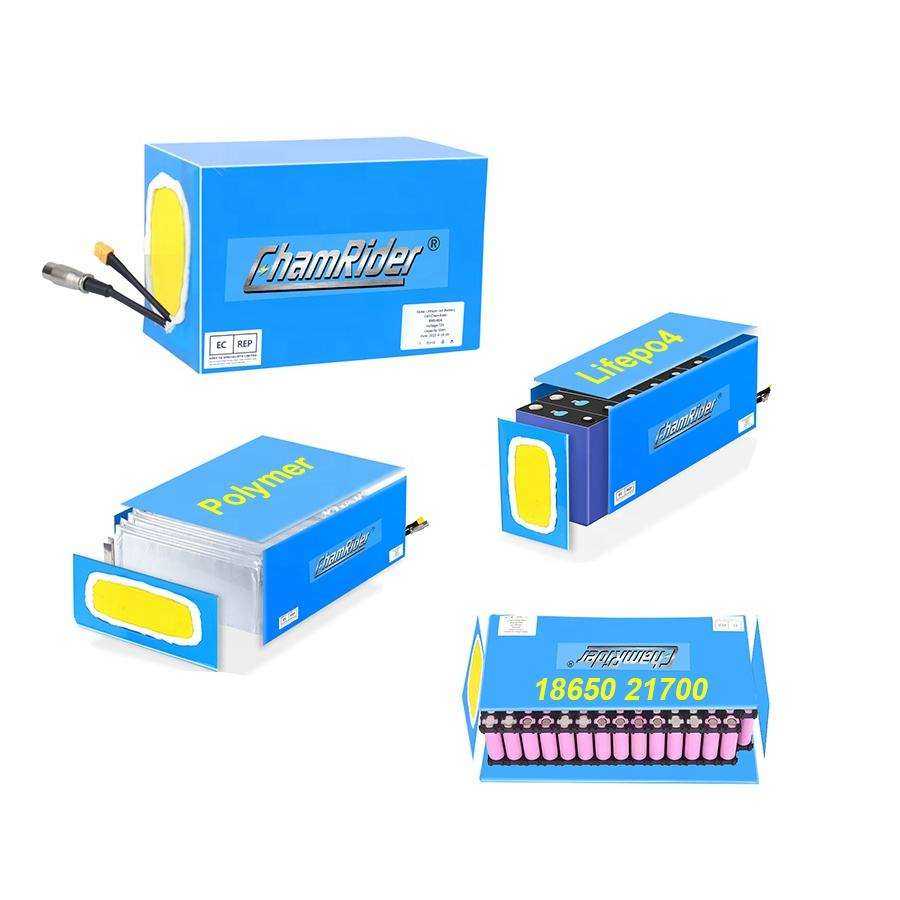
Cylindrical cells (18650, 21700) are more compact, proven, and easy to assemble in parallel/series. Prismatic LFP cells offer higher volumetric density for large packs but are heavier at equal capacity.
How does fast charging work for e-bike batteries?
Fast charging increases the charging current (from standard 2A to 5A or even 10A) to reduce charge time. It requires a compatible charger and a BMS that allows high currents without degrading the cells.
What communication protocol does the Chamrider BMS use?
Chamrider BMS units use the UART (RS485) protocol for communication with displays and controllers. This standard protocol is compatible with most European conversion kits.
The BMS (Battery Management System) is the electronic core that protects the pack cell by cell and manages communication with the motor controller. It monitors each cell’s voltage in real time (high cutoff at 4.2 V, low cutoff at 2.5–3.0 V depending on chemistry), tracks charge and discharge current (cutting off on short-circuit detection within milliseconds), and monitors pack temperature (operational range 0–45 °C). ChamRider BMS units perform passive cell balancing at the top of each charge: cells that reach 4.2 V first have their excess energy bled through a bypass resistor while remaining cells finish charging, ensuring voltage uniformity across the entire pack after every session.
Cylindrical cells (18650 or 21700) and prismatic cells represent different engineering trade-offs. Cylindrical cells have mechanically robust steel casings, benefit from decades of large-scale standardized manufacturing, and cool naturally through inter-cell air gaps. Prismatic cells achieve higher volumetric integration density — less wasted space in the pack housing — but require more careful thermal management because their flat surfaces create uneven heat distribution under load. For European e-bike applications where ambient temperatures remain moderate and mass production cost matters, cylindrical cells remain the dominant format with the deepest industrial maturity.
Active cell balancing, unlike passive balancing, transfers energy from higher-charged cells to lower-charged ones via an inductive DC-DC circuit rather than dissipating the difference as heat. This approach is still uncommon in mainstream e-bike packs due to circuit cost, but becomes relevant for high-capacity packs (800 Wh and above) where a single weak cell can reduce effective pack range by 10–15 % as the BMS cuts off to protect it. ChamRider integrates active balancing in its high-capacity range — a technical difference that becomes measurable after 300–400 cycles, when passive-balanced packs start showing visible cell divergence.
Lithium-Ion vs. LiFePO4 — Which Technology Is Right for You?
Chamrider offers two proven cell technologies: Lithium-Ion (Li-Ion) and Lithium Iron Phosphate (LiFePO4). Li-Ion batteries deliver the highest energy density — more range per kilogram — making them ideal for commuters and touring cyclists who prioritise maximum reach. LiFePO4 batteries are safer, longer-lasting (up to 2,000 cycles), and more heat-resistant, but slightly heavier for the same capacity.
The integrated BMS (Battery Management System) monitors in real time: cell voltage (± 5 mV accuracy), temperature (automatic cut-off above 60 °C), total discharge, and charge cycles. When cell voltage difference exceeds 50 mV, the BMS initiates a balancing sequence to keep all cells at equal charge levels, extending overall pack lifespan.
Frequently Asked Questions about eBike Battery Technology
How long does a Chamrider battery last?
Chamrider Li-Ion batteries retain over 80% capacity for 800 to 1,200 full charge cycles. With daily charging, this translates to 2–3 years of intensive use. LiFePO4 models reach up to 2,000 cycles.
Can I leave the battery in a hot car?
Not in summer in direct sunlight — temperatures above 45 °C significantly accelerate capacity loss. Store the battery at 15–25 °C at a 40–80% charge level for extended periods of storage.
Can I use any charger with my Chamrider battery?
Use only the supplied charger or a Chamrider-approved equivalent with the correct output voltage and connector. An incompatible charger can overload the BMS and cause permanent cell damage — this type of damage is not covered under warranty.
See also : Chamrider Batteries, Accessories, Chamrider Brand.
The multi-layer BMS — per-cell monitoring, active balancing above 800 Wh, and automatic cutoffs — is what separates a ChamRider pack still performing after 800+ cycles from a generic pack that degrades within 200.